

"I've Been on Acid Blockers for 7 Years. I Want Off But Every Time I Try, the Burn Comes Back Worse."

You didn’t plan to be on acid blockers for this long.
When your doctor first prescribed them, it was supposed to be temporary — 8 weeks, maybe 12. That was years ago. Now you take them every morning without thinking.
But lately, something's changed. Maybe you read about the long-term concerns. Maybe your doctor mentioned tapering off. Maybe you tried to stop on your own — and within 48 hours, the burning came back worse than it ever was before you started.
Here’s what nobody explained: the rebound isn’t a sign that you need the medication forever. It’s a sign that your esophageal tissue never healed while you were on it.
The Rebound Trap: Why Stopping PPIs Feels Worse Than the Original Problem


This is the part your doctor may not have had time to explain in detail:
PPIs work by suppressing acid production in your stomach. When you take them daily for months or years, your stomach adapts it tries to compensate by producing more acid-producing cells. As long as you keep taking the PPI, this doesn't matter. The drug keeps suppressing the extra capacity.
But the moment you stop, all those extra acid-producing cells fire at once. The result: rebound acid hypersecretion a surge of acid that's often worse than what you had before you started the medication [1].
A landmark study found that even healthy volunteers who had never had reflux developed acid-related symptoms after taking PPIs for just 8 weeks and then stopping [1]. The medication itself had created the dependency.
This is the trap:
- You can't stop because the rebound is unbearable
- You can't stay because you're concerned about long-term effects
- Your doctor says "taper slowly" but your esophagus screams at every dose reduction
The missing piece: your esophageal lining never rebuilt its natural defenses while the PPI was doing all the work. The tissue is just as fragile as it was before you started maybe more so. That's why every reduction feels like starting over.


What the Research Says About Long-Term PPI Use
PPIs have helped millions of people. They have a clear role in managing reflux. But published research has raised questions about extended use that are worth understanding:
Published concerns associated with long-term PPI use include:
- Reduced absorption of key nutrients including magnesium, calcium, iron, and vitamin B12 [2]
- Associations with increased risk of bone fractures, particularly hip fractures in older adults [2]
- Associations with increased risk of kidney disease in observational studies [2]
- Increased susceptibility to certain gut infections, including C. difficile [3]
- Research suggesting that 50-70% of PPI prescriptions may lack a clear clinical indication [4]
Important context: These are associations from observational studies — not proof of causation. PPIs remain appropriate and important for many people. The decision to reduce or stop PPIs should always be made with your doctor.
But if you and your doctor have decided it's time to explore tapering, the question becomes: how do you support your esophagus through the transition?


The Tissue Gap: What PPIs Were Never Designed to Do
PPIs do one thing extremely well: suppress acid production. They're the most effective acid-reducing medication available.
But here's what they don't do:
- They don't coat your esophageal lining
- They don't support tissue rebuilding in the esophagus
- They don't form a protective barrier against reflux that still occurs
- They don't address pepsin or bile — which also damage tissue
- They don't replace the nutrients they may deplete over time
This is why you can take a PPI for years and still have symptoms. Up to 40% of people on maximum-dose acid blockers still experience discomfort [5]. And it's why stopping feels so brutal — the tissue was never supported, just shielded from acid. Remove the shield, and bare tissue meets rebound acid.
Successful tapering requires tissue support. Your esophagus needs to rebuild its natural defenses so it can handle life without maximum acid suppression.

Tissue Support for the Transition: What EsoRepair™ Does That PPIs Don't
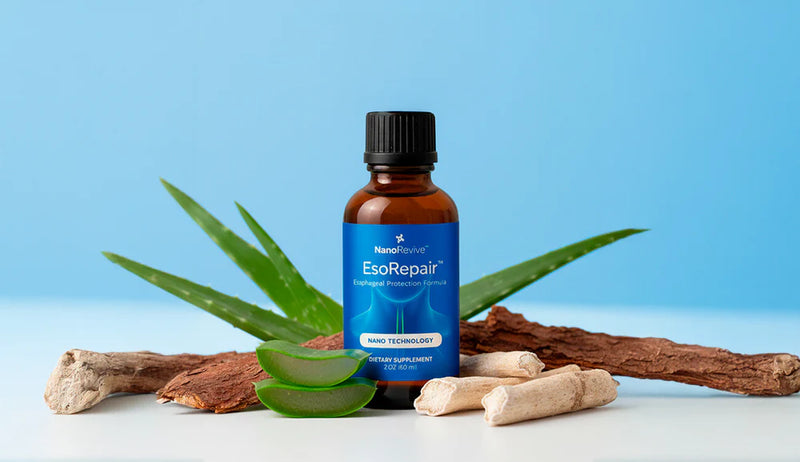
EsoRepair™ was developed by a gastroenterologist specializing in esophageal mucosal health. It's designed to provide the tissue-level support that acid blockers were never built to deliver — whether you're staying on PPIs, tapering down, or exploring alternatives with your doctor.
It's a liquid you sip slowly. As it moves down, nano-sized particles coat the esophageal lining directly. Here's what each layer does:
- Marshmallow root + slippery elm — mucilage botanicals that form a protective blanket on tissue. This physical coating is especially valuable during tapering when rebound acid hits fragile tissue
- Sodium alginate — creates a "raft" above stomach contents that reduces reflux reaching the esophagus. Also inhibits pepsin and bile salts [6]
- Zinc-L-Carnosine — adheres to damaged tissue and supports integrity during oxidative stress [7]
- Hyaluronic acid + chondroitin sulfate — form a film-like coating over sensitive areas
- L-Glutamine — primary fuel for esophageal lining cells. Supports the tissue rebuilding that needs to happen for successful PPI reduction
- Vitamin D3 + Zinc — nutrients that long-term PPI use may deplete. Supports immune function and tissue maintenance
- Quercetin — antioxidant support for tissue under oxidative stress
EsoRepair™ is not a PPI replacement. It's a tissue support formula designed to complement your medical care. If you're considering reducing your PPI dose, work with your doctor — and give your esophagus the support it needs for a smoother transition.

Published Research on Key Ingredients
*Results based on published studies of individual ingredients. Doses/forms may differ. Individual results vary. Not intended to diagnose, treat, cure, or prevent any disease. Do not stop or reduce PPI medication without consulting your doctor.
The 90-Day Tissue Support Protocol
Whether you're staying on PPIs, tapering with your doctor, or looking for additional daily support EsoRepair™ is designed as a 90-day structured protocol:

Weeks 1–3: The Coating Phase
Mucilage botanicals and alginate coat the esophageal lining, creating a physical barrier. Users describe less breakthrough burning even on days when reflux breaks through their PPI.

Weeks 4–6: The Rebuilding Phase
Hyaluronic acid, chondroitin sulfate, glutamine, and zinc support tissue maintenance. This is the phase where the lining starts to strengthen building the resilience you'll need if tapering.

Weeks 7–9: The Resilience Phase
Aloe vera, DGL licorice, and quercetin support mucosal resilience and a healthy inflammatory response. Users who are working with their doctor to taper report this is when reductions become more manageable.

Weeks 10–12: The Independence Phase
Your esophagus is functioning with stronger natural defenses. Users describe feeling less dependent — not because they stopped their medication overnight, but because they gave their tissue the support it needed to handle life with less acid suppression.
Backed by a90-day money-back guarantee.If you don't see a meaningful difference, full refund.
Independent Clinician Evaluations
Clinicians receive product samples and are never compensated to submit evaluations.

Helps reduce inflammation with vitamin D and antioxidant support
Chronic reflux can be uncomfortable, potentially triggering ongoing inflammation in the esophagus that can disrupt daily life.
Additional clinician details can go here.

Creates a protective barrier to help control acid reflux and soothe irritated tissue
For those who tend to feel a burning sensation in their throat or chest after meals, this supplement is worth considering.
Additional clinician details can go here.
What Customers Are Saying
 ★★★★★“I went to the ER twice because the chest burn felt like heart issues.”Maya P.
 ★★★★★“Nothing touched the lump-in-throat feeling. Within weeks, swallowing felt normal.”Rafael Q.
 ★★★★★“Two months in, I can eat without rehearsing disaster.”Leah S.
Questions People Ask About PPIs and EsoRepair™
"Can I stop my PPI and just take this instead?"No — and we'd never suggest that. EsoRepair™ is not a PPI replacement. If you're considering reducing your PPI dose, always work with your doctor. EsoRepair™ is designed to provide tissue support alongside your medical care, not substitute for it.
"Can I take this WITH my PPI?"Yes. That's actually how most of our customers use it. PPIs reduce acid production. EsoRepair™ coats, soothes, and supports the tissue that PPIs don't address. They work on different parts of the problem.
"Will this help with rebound acid if I'm tapering?"EsoRepair™'s mucilage botanicals and alginate form a physical coating on the esophageal lining. This can provide a layer of comfort during the tapering process — but we always recommend tapering under medical supervision.
"Does this replace the nutrients PPIs deplete?"EsoRepair™ contains Zinc (16.5 mg) and Vitamin D3 (2,000 IU), both of which are among the nutrients that long-term PPI use may affect. However, it's not formulated as a comprehensive nutrient replacement — consult your doctor about specific deficiencies.
"It's expensive."$1.63/day on subscription. Consider the cost of years of PPIs, specialist visits, and the side effects you're trying to avoid. 90-day money-back guarantee — zero risk.
ONLY NOW: Get Extra 30% Off
- Doctor-formulated with 11 research-backed ingredients
- Liquid nano delivery coats tissue PPIs can't reach
- 90-day money-back guarantee
You didn’t plan to be on acid blockers forever. But you can’t stop because nobody addressed the tissue underneath.
References
[1] Reimer C, et al. Proton-pump inhibitor therapy induces acid-related symptoms in healthy volunteers after withdrawal of therapy. Gastroenterology. 2009.
[2] Long-term PPI use is associated with bone fractures, kidney disease, B12 deficiency, and nutrient malabsorption.