

That Constant Throat Clearing Isn't Allergies. It's Something Your Doctor Might Be Missing Entirely.

You clear your throat 50 times a day. Your voice is strong in the morning but gone by dinner. There's a lump that won't go away no matter how many times you swallow. You have a cough that starts after meals and nobody - not your GP, not the allergist, not the ENT - can explain it.
You've tried allergy meds. Inhalers. Nasal sprays. Antibiotics. Nothing touches it.
Your family says you sound different. Your grandkids ask why your voice is "scratchy." You used to sing in the car. Now you can barely get through a phone call without clearing your throat.
Here's what nobody told you: you don't have allergies. You don't have a cold that won't go away. You have acid silently damaging your throat - and you may not have a single symptom of heartburn.
This condition is called Laryngopharyngeal Reflux (LPR) - also known as "silent reflux." It affects up to 10% of the population and causes over 50% of chronic hoarseness cases. Yet it remains one of the most misdiagnosed conditions in medicine [1].

Does This Sound Like You?
- Constant throat clearing - 87% of LPR patients do this. It feels like mucus you can never get rid of. Allergy meds don't help because it's not allergies [2]
- Hoarseness that gets worse through the day - your voice breaks mid-sentence, fades by afternoon, sounds raspy to everyone but you didn't notice it creeping in
- A lump that won't go away - the globus sensation. You swallow but it stays. It's not a lump - it's inflamed tissue you can feel but your doctor can't see
- A cough nobody can diagnose - dry, persistent, worse after meals. Inhalers are useless. You've been told it's post-nasal drip, but decongestants don't work either
- Thick sticky mucus in your throat - "gunk" that won't clear. Not from your sinuses - from your esophagus producing excess mucus to protect itself from acid it was never built to handle
- Difficulty swallowing - pills scraping, food feeling stuck, tightness when you eat. The passage is inflamed, not blocked
- Morning soreness - waking with a raw, burning throat. Acid reached your voice box overnight while you slept
Here's the key: fewer than 20% of people with LPR ever feel classic heartburn [3]. That's why it's called "silent" reflux. The acid does its damage above the esophagus - in your throat, larynx, and airway - without triggering the burning sensation that would tell you it's reflux.
If you checked 3 or more symptoms above and heartburn is NOT your main complaint, you are likely dealing with silent reflux. And that changes everything about how it should be addressed.
 CHECK AVAILABILITY
Why Your Doctor Missed It - And Why Nothing You've Tried Has Worked
The average LPR patient seesmultiple specialistsand undergoesmultiple testsin their first year - often without answers[4]. Here's why:
Your GI doctor looks at the wrong place.GERD damages the lower esophagus. LPR damages the throat, larynx, and airway - above where a standard endoscopy focuses. Your GI scope may come back "normal" because the damage is higher up.
Your ENT sees inflammation but can't find infection.They see redness and swelling in your larynx. They test for bacteria, viruses, allergies. Everything comes back negative. Because the damage is chemical, not infectious.
Your allergist treats what isn't there.The throat clearing and mucus look like allergies. But antihistamines, nasal sprays, and allergy shots don't help - because the trigger isn't pollen or dust. It's pepsin and acid from your stomach.
Your GP prescribes a PPI.It helps a little, maybe. But up to40-50% of LPR patients don't respond adequately to PPIs[5]. Because the main agent of damage in LPR isn't just acid - it's an enzyme calledpepsinthat PPIs can't address.

The Pepsin Problem: Why This Is Harder to Fix Than Regular Reflux
Here's the biology that changes everything about how LPR should be treated:
Your larynx - your voice box - has zero of the protective mechanisms your esophagus has. No acid-neutralizing enzymes. No thick barrier lining. No rapid clearing mechanism. Research shows that as few as 3 reflux episodes can cause laryngeal damage, while your esophagus can handle 50 per day [6].
But it gets worse. The main destroyer isn't acid alone - it's pepsin, a digestive enzyme from your stomach. When pepsin reaches your throat, it gets absorbed into your tissue and stays there [7]. Even after the reflux episode is over. Even when no acid is present.
The next time ANY acid touches your throat - even from food, a sip of coffee, or a mild reflux episode - that dormant pepsin reactivates and resumes destroying tissue from the inside.
This is why PPIs often fail for LPR:
- PPIs reduce acid - but pepsin causes damage even in non-acid reflux
- PPIs don't remove pepsin already embedded in your throat tissue
- PPIs work on the stomach - they don't coat or protect the throat
- LPR requires at least 6 months of treatment vs 8 weeks for typical GERD [8]


Why a Liquid You Sip Slowly Is the Only Format That Makes Sense for Silent Reflux
Think about this: LPR damages your throat. So why would you take a capsule that drops straight past your throat into your stomach?
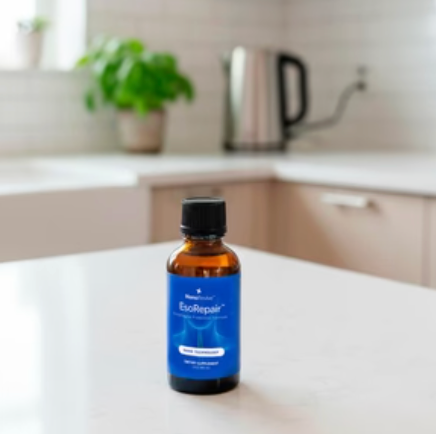
EsoRepair was developed by a gastroenterologist specializing in esophageal mucosal health. It's a liquid formula you sip slowly. As it moves down, nano-sized particles of soothing botanicals coat the entire upper tract - including the throat, larynx, and upper esophagus where silent reflux does its damage.
This matters for LPR specifically because:
- Marshmallow root and slippery elm form a mucilage layer that physically coats irritated laryngeal tissue on contact - soothing that raw, inflamed throat from the first sip
- Sodium alginate creates a "raft" above stomach contents - and research shows alginates also inhibit pepsin and bile salts, addressing the non-acid damage that PPIs miss [9]
- Hyaluronic acid and chondroitin sulfate form a protective film over pepsin-depleted tissue
- Zinc-L-Carnosine adheres to damaged tissue and supports integrity during oxidative stress
The delivery format IS the differentiator. For a condition that damages the throat, you need a formula that actually reaches the throat.

Published Research on Key Ingredients
The 90-Day Protocol for Silent Reflux Recovery
LPR takes longer to resolve than regular reflux - clinical guidelines recommend a minimum of 3-6 months. Research shows 60% improvement at 3 months[13]. EsoRepair is designed as a 90-day structured protocol:

Weeks 1-3: The Coating Phase
Marshmallow root, slippery elm, and alginate begin coating upper esophageal and laryngeal tissue. Users report less throat clearing, smoother swallowing, and the "lump" starting to ease. 90% of marshmallow root users felt soothing within 10 minutes[10].

Weeks 4-6: The Repair Phase
Hyaluronic acid, chondroitin sulfate, and glutamine support tissue maintenance in pepsin-depleted areas. Voice fatigue improves. Cough frequency decreases. Many users start trusting their voice again - holding conversations without clearing their throat every 30 seconds.

Weeks 7-9: The Resilience Phase
Aloe vera, DGL licorice, and quercetin support mucosal resilience and a healthy inflammatory response. Throat symptoms stabilize. The post-nasal drip sensation fades. The morning soreness that's been waking you up for months starts to quiet.

Weeks 10-12: The Renewal Phase
Your throat is functioning on a new baseline. Voice holds steady all day. The cough is quiet. The globus is gone. For many, this is the moment they realize the "allergy" they've had for years was never an allergy at all.
Backed by a90-day money-back guarantee.If you don't see a meaningful difference, full refund.
Independent Clinician Evaluations
Clinicians receive product samples and are never compensated to submit evaluations. Learn more

Helps reduce inflammation with vitamin D and antioxidant support
Chronic reflux can be uncomfortable, potentially triggering ongoing inflammation in the esophagus that can disrupt daily life. I’m happy to see vitamin D3 in this formula because it can play an important role in calming inflammatory signals throughout the body. In fact, research in animal models of reflux esophagitis suggests that vitamin D3 can help reduce key inflammatory markers. I appreciate that EsoRepair pairs it with quercetin, a plant-based antioxidant that may help protect cells from oxidative stress caused by repeated acid exposure.
○ Soothes inflammation
○ Aids immunity
○ Vitamin nutrients

Creates a protective barrier to help control acid reflux and soothe irritated tissue
For those who tend to feel a burning sensation in their throat or chest after meals, this supplement is worth considering. Sodium alginate is interesting because it can form a gel-like protective barrier.
○ Reflux control
○ Quick relief
○ Soothing barrier
Clinician reviews powered by frontrowMD
"I Sound Like Myself Again"
Nothing touched the lump-in-throat feeling. Food felt stuck, my voice was hoarse, and lying flat was impossible. This is the first thing that actually soothed my esophagus. Within weeks, swallowing felt normal and my voice came back.
Rafael G.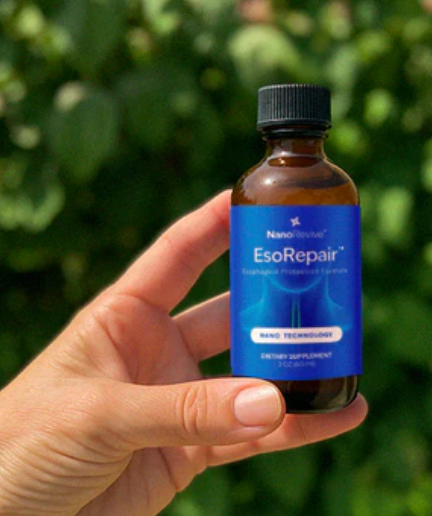
I went to the ER twice because the chest burn felt like heart issues. Four weeks in, I slept through the night for the first time in years. The panic and palpitations are finally quiet.
Maya P.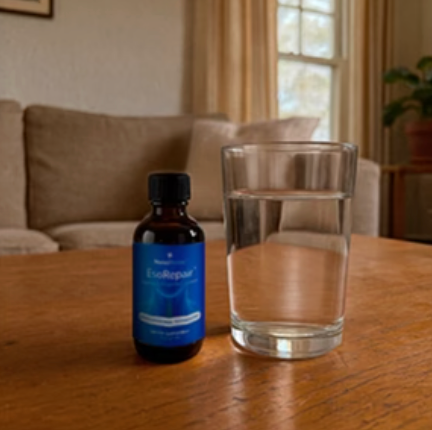
These issues wrecked my mental health. I was terrified of every meal and living in constant flare-up fear. Two months in, I can eat without rehearsing disaster. I feel calmer, clearer, and like myself again.
Leah S.Questions Women With Silent Reflux Ask Most
I do not have heartburn. How can it be reflux?
That is exactly what makes LPR silent. Fewer than 20% of people with this condition feel heartburn. Acid and pepsin travel higher - to your throat and voice box - without triggering the classic burning sensation. Your throat gets damaged but your chest feels fine.
I have been on a PPI for years. Can I still use this?
Yes - and most customers do. PPIs reduce acid production. EsoRepair coats and supports the throat tissue that PPIs cannot reach, and addresses pepsin, which PPIs do not touch. Always consult your doctor before changing your medication routine.
How long before my voice comes back?
Throat tissue heals slower than esophageal tissue. Clinical guidelines recommend 3-6 months for LPR. Most users report throat clearing and comfort improvements in weeks 2-4. Voice improvements typically follow in weeks 4-8. The 90-day guarantee covers the full recovery window.
I do not want to be locked into a subscription.
Cancel anytime. One click. No phone calls, no hoops. Start with a single bottle if you prefer.

ONLY NOW: Get Extra 30% Off
- Doctor-formulated with 11 research-backed ingredients
- Liquid nano delivery - coats throat and larynx directly
- Alginate blocks pepsin and bile - not just acid
- 84% of surveyed customers take it daily
- 90-day money-back guarantee
You have been clearing your throat for years. You have been told it is allergies, post-nasal drip, aging, stress. You have taken pills that did not help and spent money on sprays that did not work.
It is time to try the one thing designed to actually reach the tissue that is being damaged. A liquid formula that coats your throat on the way down - not a pill that skips past it.
Try EsoRepair risk-free with 30% OFF. If it does not make a difference in 90 days, full refund. No questions.
References
[1] Lechien JR, et al. LPR. StatPearls 2023. 10% of ENT visits = LPR. 50%+ of chronic hoarseness = LPR.
[2] StatPearls. Heartburn in 20% of LPR vs 80% of GERD.
[3] PMC11056915. LPR damage occurs above standard GI endoscopy focus.
[4] PMC9012673. LPR patients see multiple specialists, undergo multiple tests.
[5] El-Serag H, et al. Persistent reflux symptoms on PPI therapy. Aliment Pharmacol Ther. 2010.
[6] Koufman JA. Otolaryngologic manifestations of GERD. Laryngoscope. 1991.
[7] Johnston N, et al. Pepsin in laryngeal biopsies of LPR patients. Ann Otol Rhinol Laryngol. 2007.
[8] PMC9012673. Alginates inhibit pepsin and bile salts as adjunct to PPI therapy.
[9] NanoRevive EsoRepair Customer Feedback Survey. n=50-61 respondents. May 2026.
[10] Fink C, et al. Marshmallow root for irritative cough. Complement Med Res. 2018.
[11] Hayashi K, et al. Polaprezinc protects against esophagitis. Int J Clin Oncol. 2016.
[12] ScienceDirect 2020. 60% improvement in reflux-related cough at 3 months of treatment.
Disclosure
The information presented on this website is not intended as specific medical advice and is not a substitute for professional treatment or diagnosis. These statements have not been evaluated by the Food and Drug Administration. This product is not intended to diagnose, treat, cure, or prevent any disease.
If you are experiencing persistent throat symptoms, voice changes, or difficulty swallowing, please consult with an ENT specialist or gastroenterologist for proper evaluation.
All trademarks on this site whether registered or not are the property of their owners. This site is not a part of the Facebook website or Meta INC. Additionally, this site is not endorsed by Facebook in any way. Facebook is a trademark by Meta INC.